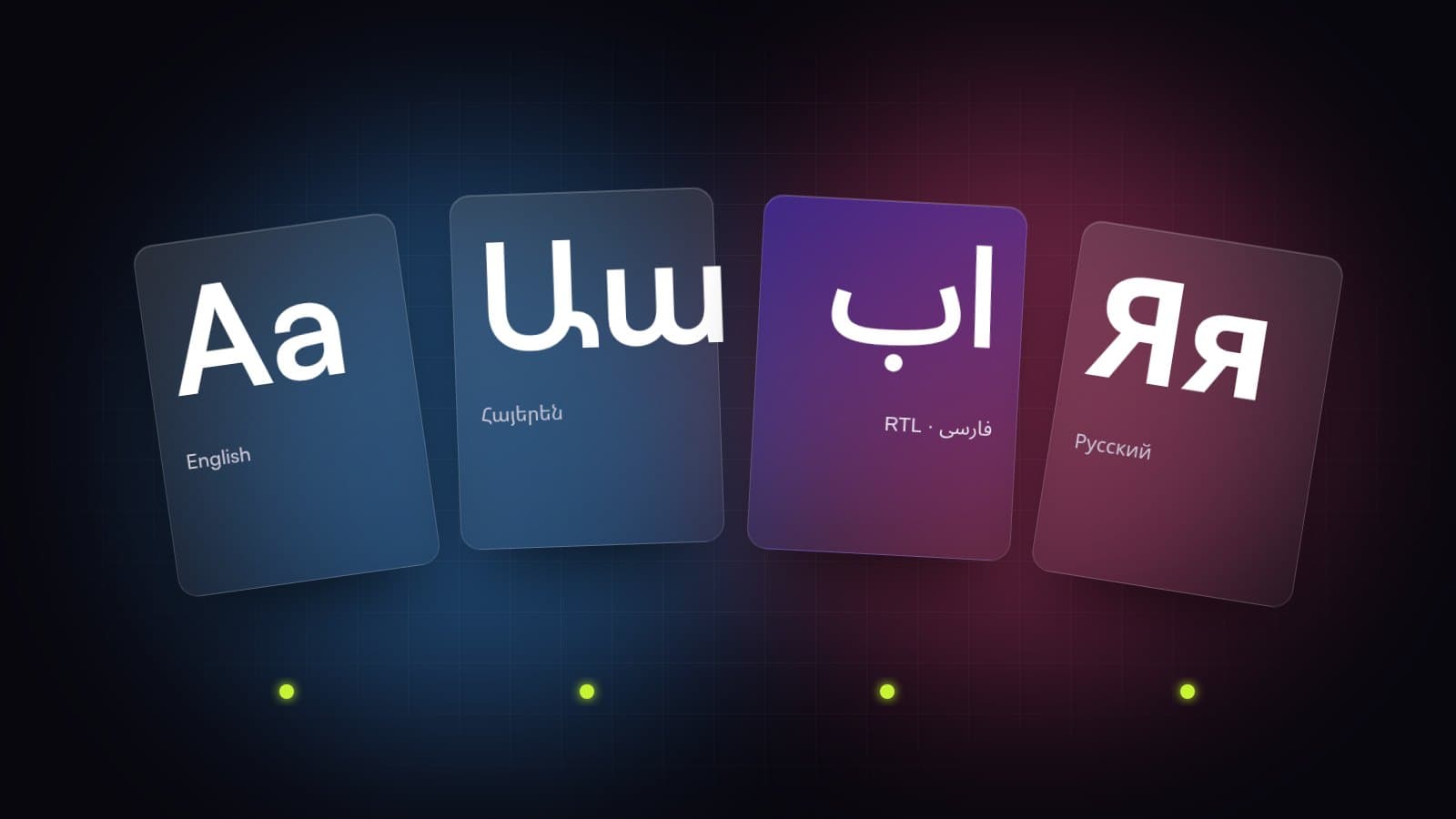
A multilingual website is not one site with four dictionaries. Every language changes the length of text, the shapes of letters and sometimes the direction of the whole page. If the design ignores this, the second language always looks like a translation.
Choose fonts per script
Few typefaces cover Latin, Armenian, Cyrillic and Persian well. We pair a primary Latin font with dedicated fonts for each script, so every language gets letters designed for it. Persian in particular needs a font built for its joined letters and letter-spacing must stay at zero, or the words break apart.
Design for the longest language
Russian and Armenian headlines are often far longer than English ones. We test every component with the longest real text, let headings wrap gracefully on phones and never fix buttons to a width that only fits English.
Right-to-left is a mirror, not a flip
- Layout, navigation and reading order mirror for Persian.
- Arrows and progress indicators change direction; logos, numbers, code and email addresses do not.
- Animations should move the way the reader reads.
Let editors control every word
Content changes after launch. Every text on our sites buttons included is editable per language in the admin panel, with English as a safe fallback when a translation is missing.
The goal is simple: a visitor should never be able to tell which language the site was designed in first.